
In a workshop on “Solidarity: mobilization vs organization” at DARE2025, organized by CWM, in Zimbabwe, George Schmidt asked: What does solidarity smell like? Various people responded: the coffee after a worship service, meals prepared in community kitchens, the aroma of cake baking. Nearly everyone associated the smell of solidarity with food. I found this fascinating and began to wonder… What does ecumenism smell like?
We can take time to reflect on this question. Looking at the history of ecumenism, we see that the word OIKOUMENE has deep roots in the context of Roman imperialism, which sought to impose the Pax Romana as a “civilizing” model. Christianity emerged within this colonial Roman context, and the early ecumenical councils, such as the Council of Nicaea, were considered ecumenical only because they religiously legitimized the Empire. Julio de Santa’Ana points out that, throughout history, from the Hellenistic period onward, the terms oikos and oikoumene were used in secular contexts to distinguish between the civilized world (Rome – oikoumene) and the world of the so-called barbarians. As Christianity developed within this imperial space—especially after Constantine’s conversion—it gradually shaped itself into an empire: Christendom. In this vision, the oikoumene (the Roman Empire) represented the civilized world, while the rest—those yet to be conquered and colonized—were deemed barbaric (1991). Gladson Janthanna, in Decolonising Oikoumene (2020, CWM), explores this dimension of cultural homogenization that so-called “ecumenism” promoted by adopting the Pax Romana as a way to maintain order. So, what does this ecumenism smell like?
It is evident that the global ecumenical movement is in crisis, not only in Latin America and the Caribbean but worldwide. External factors play a role, such as the rise of religious fundamentalism and the far right. However, internal factors also demand urgent attention if we are to undergo metanoia—a change of direction—in how we live out ecumenism. One key internal challenge is that the institutionalization of ecumenism has distanced people from its transformative potential on personal, spiritual, and social levels. By leaving everything in the hands of ecumenical organizations and church leadership, the grassroots—the people—have felt disconnected from popular ecumenical construction. This institutionalized ecumenism fails to engage with the more popular sectors of Christianity, such as Pentecostalism, which encompasses a significant portion of impoverished communities in the Global South.
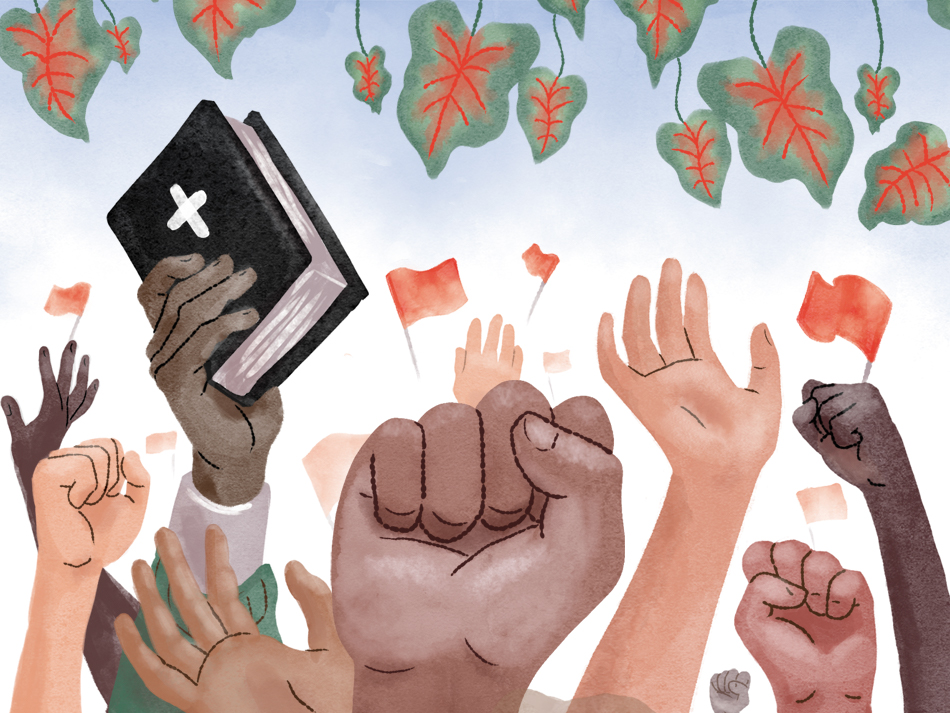
Effective Love as the Revitalization of Ecumenism
The month of February marks both the birth and death of the great revolutionary priest, the Colombian Camilo Torres Restrepo. bell hooks once said: A culture that is dead to love can only be resurrected through spiritual awakening. When we look at the life and legacy of Camilo Torres, we witness a living and active practice of transformative ecumenism.
Camilo Torres became a priest out of love for the poor, believing that the true mission of the Christian church was to be an instrument of struggle for the dignity of the people—a church that serves humanity, grounded in love for one’s neighbor. Because of this profoundly Christian love, he was led to renounce the formal priesthood, yet he never ceased to be a priest. As he declared:
“I have left the privileges and duties of the clergy, but I have not ceased to be a priest. I believe I have given myself to the Revolution out of love for my neighbor. I stopped saying Mass to realize this love for my neighbor in the temporal, economic, and social spheres. When my neighbor has nothing against me, when I have carried out the Revolution, I will return to say Mass, if God permits.” (TORRES, in Garcia, 2021)
He then dedicated himself entirely to revolutionary action. First, by planting in the minds of university youth and in the heart of his pastoral work the urgency of transforming the structures of his homeland, Colombia. He envisioned a revolution that embraced all the people, redistributed wealth, reallocated land—both rural and urban—and definitively broke with the predatory elite that had long allied itself with the U.S. empire. Later, he joined the campesinos in guerrilla resistance, where, perhaps by chance or due to inexperience, on February 15, 1966, Camilo Torres fell in combat while attempting to recover a rifle from enemy forces.
Camilo’s journey into revolution was not an isolated decision but a deep response to the reality he observed in Colombia. As a sociologist, trained at the National University of Colombia and later in Belgium, he rigorously studied the structures of inequality and oppression. Returning to Colombia, he co-founded the Sociology Faculty at the National University and engaged in profound analysis of class struggle, coloniality, and the economic structures that perpetuated poverty. (GARCIA, 2021)
While serving as chaplain at the university, he became increasingly critical of the Catholic Church’s complicity with the ruling elite. He insisted that the Church’s role was to stand alongside the oppressed and act as a vehicle for their liberation. His radical theological vision led him to advocate for what he called Effective Love, Amor Eficaz —a love that does not remain in abstraction but materializes in concrete action for justice.
His increasing involvement in politics led him to form the United Front of the People, a political movement aimed at uniting workers, students, peasants, and marginalized communities in the struggle against imperialist exploitation and the oligarchic control of Colombia. His speeches and writings became a powerful call for political mobilization, urging Christians to understand that faith and revolution were inseparable when the reality of suffering was so evident.
Reflecting on the life of Camilo Torres, we must ask: What does our ecumenism smell like? We cannot limit our ecumenical discourse to theological and abstract dimensions alone; rather, ecumenism must be rooted in the concrete realities of people’s lives. As Camilo himself put it: “Why do we argue about whether the soul is mortal or immortal instead of agreeing that hunger is indeed mortal?” In his text Crossroads of the Church in Latin America, he affirmed: “We will not be judged merely by our good intentions, but above all by our actions in favor of Christ, who is represented in each of our neighbors: ‘I was hungry, and you did not give me to eat; I was thirsty, and you did not give me to drink.’”
At the 4th International Colloquium on Theology for Transformative Ecumenism, held from March 19-22, 2019, at the Christian Center of Japan in Tokyo, it was affirmed that Transformative Ecumenism is an emerging, decentralized movement rooted in agendas defined by marginalized peoples and communities. More than a fixed structure, it is an inclusive movement that engages those who lead and struggle for a life marked by justice and wholeness for all.
This vision of a transformative ecumenism, deeply embedded in the realities of the peripheries and committed to justice, resonates with the practice of effective love as proposed by Camilo Torres. As analyzed by Míguez Bonino, for Camilo, love was not merely a feeling but a conscious, intelligent effort aligned with historical conditions to transform the economic and social structures that perpetuated the misery of his people. In this context, faith becomes effective through love, and this love, in turn, must be a love that transforms—an effective love. Camilo called this revolution.
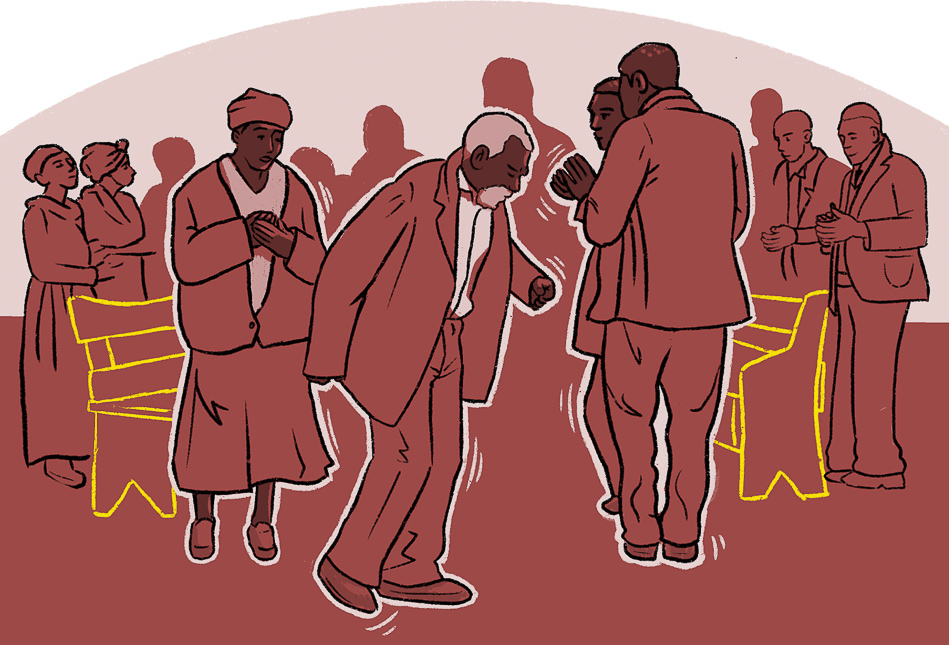
Pathways for a Transformative Ecumenical Movement in Latin America and the Caribbean
As a draft, or rather, as a thought written in pencil, as Ivone Gebara would say, I offer some pathways for a grassroots and transformative ecumenical movement in Latin America and the Caribbean. If this thought had a scent, it would be the smell of people—of workers returning from their jobs in the centers of large cities at 6:30 PM on a packed bus or subway. The smell of humanity. The mystic Rabindranath Tagore, ins said that God is not in temples with closed doors but rather:
“He is where the farmer tills the hard soil / and where the road builder is breaking stones. / He is with them in the sun and the rain, / and his garments are covered with dust.”
Key Points to Consider:
- The radicality of effective love, as proposed by Camilo Torres, lies in our ecumenism being grounded in anti-capitalist, anti-imperialist, anti-colonial values, and against all injustices of gender, sexuality, race, and ethnicity. We must take historical materialism and its intersections seriously in our struggle, shifting ecumenism away from traditional councils and theological debates that have little connection with the concrete lives of the working class and the faithful in our churches.
- Another crucial point is intergenerational dialogue. We need to dedicate ourselves to forming new leaders within ecumenical militancy and liberation theology. In institutional spaces, young ecumenical activists are often seen as mere labor rather than as co-creators of ecumenical knowledge and practice. It is necessary not only to provide physical space for youth but also to give them room to question, propose new ideas, and develop new methods and ways of being ecumenical in today’s world.
- Karl Rahner said: “The Christian of the next millennium will either be a mystic or will not exist at all.” Expanding on this, I would add that the Christian of the next millennium must also be interfaith. Our transformative ecumenism must be for everyone, fostering solidarity that transcends religious beliefs and builds bridges with other traditions. This must go beyond a doctrinal or theological interreligious dialogue—rather, we must ask: What moves us? What issues affect us all? How can we, through our traditions, resist and struggle against the ills of capitalism, war, racism, climate injustice, gender violence, and more?
- Even though we believe that effective love is the construction of justice in the here and now, one of the driving forces behind this, for Camilo Torres, was spirituality. As an ecumenical and liberation theology movement, we must not abandon spirituality and the mysticism of our traditions. Faith-based organizing is essential, whether in churches, small prayer groups, or Bible study circles, because faith moves the working class of Latin America and the Caribbean. We on the left have always known this, yet we have often forgotten and abandoned this space due to pressing political urgencies, leaving faith to be seen only as a personal or devotional matter. As Ángel Garcia says: “In politics, there are no empty spaces.” Spirituality is also political. The two must walk together. The right has exploited this void, presenting itself as the only legitimate form of Christianity, based on religious fundamentalism. We must reclaim and engage in our spirituality with honesty and a sincere heart.
Thus, for transformative ecumenism in Latin America to remain faithful to the demands of its people and the challenges of our time, it must be aligned with this revolutionary practice of effective love—a love that not only feels but acts, struggles, and transforms.
The scent of transformative ecumenism is not that of incense in empty cathedrals or the sterility of bureaucratic meetings. It carries the aroma of sweat from workers on overcrowded buses, the fragrance of bread shared in community kitchens, the rich earth tilled by campesinos seeking dignity. It is the smell of humanity in motion, of struggle and hope intertwined. Like Tagore’s vision of God among the laborers, ecumenism must dwell where life is pulsating—among those who build, resist, and dream of a world where love is effective, justice is tangible, and faith is embodied in collective action. As Camilo Torres stated:
“But this love for one’s neighbor must be effective. […] Under the current circumstances in Latin America, we see that food, clothing, and shelter cannot be provided for the majority. Those who hold power form an economic minority that dominates political, cultural, military, and, unfortunately, even ecclesiastical power in countries where the Church owns material wealth. This minority will not make decisions against its own interests. […] Therefore, power must be taken by the marginalized so that structural economic, social, and political reforms can be enacted in their favor. This is called revolution, and if it is necessary for the realization of love for one’s neighbor, then a Christian must be a revolutionary.” (TORRES, 1981)
CAMILO TORRES, PRESENTE!

(This text was prepared for the III Jornadas por un Amor Eficaz, in the struggle and in memory of Camilo Torres, which took place on February 15, 2025. Available on YouTube)
References
4th International Colloquium on Theology for Transformative Ecumenism. Transformative Ecumenism Movement. Acesso em 26 de fevereiro de 2025. https://transformativeecumenismmovement.org/.
Avilez Álvarez, M. J. “Camilo Torres e o Amor eficaz: As origens da teologia da libertação e a Insurgência armada colombiana.” Escola Superior de Teologia, São Leopoldo, 2013. Acesso em 26 de fevereiro de 2025. http://dspace.est.edu.br.
Garcia, Angel. Tricontinental Institute for Social Research. Um retorno aos caminhos da fé e da revolução de Camilo Torres. 2021. Acesso em 26 de fevereiro de 2025. https://thetricontinental.org/pt-pt/brasil/um-retorno-aos-caminhos-da-fe-e-da-revolucao-de-camilo-torres/.
HOOKS, Bell. All about love: New visions. 2000.
Míguez Bonino, José M. Ama e faze o que quiseres. [S.l.]: Imprensa Metodista, 1971.
Tagore, Rabindranath. “Gitanjali.” In Voices of South Asia, 128–143. Routledge, 2015.
Torres Restrepo, Camilo. Cristianismo e Revolução. São Paulo: Global, 1981.
 angeliquisses